Skriet
Vad betyder ”Postrock” egentligen? Tja. Ytterligare en av tjogvis nya gatukorsningar till musikgenrer som folk använder i ivern att kategorisera visionära musikers försök att bryta igenom konventionerna.
Sedermera blir det som började som något nyskapande till en etablerad genre där band efter band plagierar och gör genren lika urvattnad som Creedence-coverbandet hemma i byhålan.
Skriet från Stockholm må använda en del beståndsdelar som förknippas med postrock – stora, atmosfäriska ljudbilder och reverbgitarrer till exempel – men det är inte rättvist att stanna där. Musiken här är visuell på något sätt. Så här: Vi lyssnar på Skriet. Vi ser framför oss välklädda, introspektiva musiker. Mörka kostymer, välklippta frisyrer, en fez. Ljusen i en stad långt nedanför planet i mörkret. Cigaretten lyser i mörkret vid ändan av bardisken. Mannen och kvinnan dansar sakta, tätt, förlorade i varandra och musiken.
Skymningsfolkrock? Inte vet vi. Ta stämningen från Bohren Und Der Club Of Gore, reverbmattorna från Tarentel, lägereldsmystiken från Chris Isaacs ballader, och krydda med en Nordpolen-minnande, stilla indiesångare. Soppan tillreds med electro-chill á la Air och lite av Ennio Morricones soundtrack. Skriet smakar av sina suggestiva skymningshymner med en nypa Angelo Badalementi/Twin Peaks-gitarrer. Upplagt för mörker alltså, men Skriets musik är varken ilsket oroväckande eller ledsen. Farlig är den endast på ett sådant där billyktor-på-motorvägen och spanande-blick-i-backspegeln-sätt.
Ni ser. Inte fan kan man kategorisera något sådant. Skriet är helt enkelt bara det mest drömska, krypande varma som hänt Sverige sedan Monica Zetterlunds blick i ”Att angöra en brygga”.
Jesper Liveröd


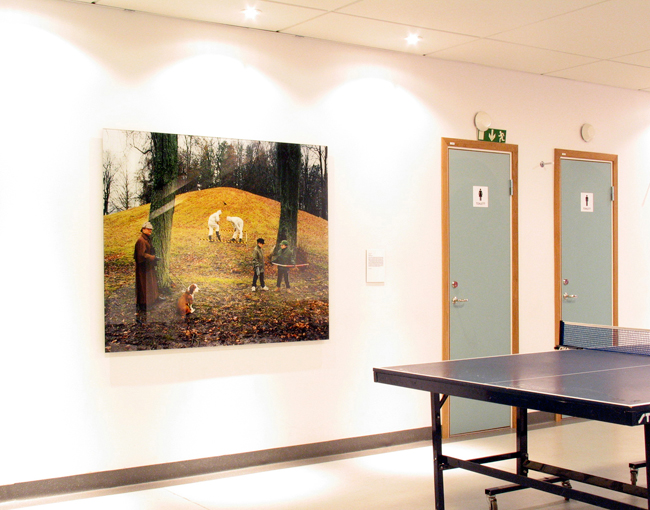
Decoration – Hammerstaskolan Botkyrka
When realizing the work “The Masquerade” artist Tova Mozard asked students, teachers, the principal, as well as parents to participate.
A series of photographs taken in the nearby area visualize several scenes that relate to the specific placement of the school building as well as different places surrounding the school. ”I have read about Botkyrka in history books and spoken with teachers at Hammerstaskolan who are very familiar with the history of Botkyrka. Furthermore, I have chosen places and stories which I found interesting and possible to transform into contemporary photography.”



DIG IT
Konstverket som jag har valt att ge titeln ”Dig it” är en gammal spade där texten DIG IT står skrivet med silverfärg på bladet.
Verket är gjort någon gång på åttitalet av min far Lars Westin.
Lars föddes 1955 i Ystad och dog 1993 i Thailand. Man fann honom på ett hotellrum och de vaga och hafsigt skrivna obduktionspappren nämner hjärtstillestånd till följd av överdos som dödsorsak.
Lars var konstnär fast saknade högskoleutbildning och fick aldrig någon egentlig karriär. Han gick konstlinjen på Östra Grevie 1973-1975 och målade, tecknade gjorde collage och tillverkade objekt. Romantiken, surrealismen, symbolismen, Arnold Böcklin och konsthantverk intresserade honom.
Att återanvända saker var något magiskt för honom, han sa att det var viktigt att omge sig med ting som var förankrad i någons själ att det gav en slags kontakt. Han samlade på människohår, ädelstenar, skrot, kedjor, tyger och leksaker, dessa sattes ihop till schamanliknande objekt, tredimensionella bilder eller användes för att utsmycka lampor, speglar och mattor. Han pratade om konsten i att få “saker att lysa” och intresserade sig för det ockulta. Konsten skulle vara ett tillstånd snarare än något fixerat.
Han var den sortens konstnär som påstod sig inte tåla dagens ljus utan helst satt uppe hela nätterna och målade lyssnades på Captain Beefheart och Greatful Dead. Han älskade lukten av oljefärg och lösningsmedel.
När jag var liten och hälsade på pappa nere i Lund brukade vi sitta på golvet i hans lilla tvåa och lyssna på Elvis Presley och rita. Man fick rita direkt på hans orientaliska matta och enligt honom var det ett sätt att ingå i en kommunikation med all den symbolik som fanns invävt i mattorna. Jag kommer ihåg hur lyxigt det kändes att få rita med hans silver och guld pennor, man fick pumpa fram bläcket genom att trycka pennspetsen mot pappret tills det rann ut i en metallic skimrande pöl. Efter Lars död ärvde jag mycket av hans saker och däribland fanns spaden, jag var tretton år då och kommer ihåg att jag tyckte spaden var cool och att jag hade den i mitt rum. Den har hängt med sen dess.
Vad som gör spaden så bra är dess enkelhet i form och utförande, en readymade med humor. Jag tycker mig även se hans cyniska världsåskådning och svarta humor speglat i den. Lars pratade mycket om döden och processen dit, för mig symboliserar spaden arbetet som det innebär att leva. Att gräva där man står eller gräva sin egen grav, det är frågan.
Tova Mozard 2009

Images on Records

Jack of all Trades
“Jack of all trades, master of none, though often better than master of one.”
The contemporary curator can truly be called a ‘jack of all trades’. Some would argue that the cliché of this multi-tasker means that the curator dabbles in many areas but is not necessarily a specialist, or a master of any of them.
Others may see the curator as a kind of polymath, a master of integration and fusion of different disciplines into a functioning and innovative whole that is more than the sum of its parts. Once treated as a sub-occupation for scholars in other disciplines, exhibition curating is breaking away to become an established field of its own. With the rise of independent, freelance curators the role has changed from caretaker and administrator to creator or auteur. This new-found independence has fuelled an explosion of experimental approaches, styles, and ways of thinking about exhibitions during the last half century. But it has also brought with it some growing pains – attempts at self-definition and identity creation, often through the formation of norms, standards, and conventions. Once no more than a tool or instrument of academia, curating has become its own, independent discipline complete with the usual degree programs and densely worded theoretical literature. This process of institutionalisation begs many questions, not the least about compatibility: if the institutionalisation and professionalisation of curating is an act of ‘main-streaming’, does it bleed something important away from the practice or, conversely, does it raise it to a new level of possibilities?
The CC7 is a group of seven young curators from different areas of the exhibition field who come together to share ideas and perspectives about curatorial practice. This biennial is produced in the context of the Stockholm University’s International Curating Management Education Program and in collaboration with the artist Tova Mozard. It is an exhibition about exhibition-making that uses the biennial format in a deliberately naive way. A far cry from the stereotypical image of the Biennial, the mega exhibition boasting a host of international artists under the directorship of a single über-curator, it is more like an inversion of it, a terminological hi-jacking filling the platform with different content. The show is thus a reflexive loop. Curatorial work formulates professional perspectives, which are distilled into discussion. The discussion is then aesthetically mediated by the artist and handed back to the curators to be presented in an exhibition. This self-interrogation is conceived as a recurring event to stimulate dialogue and exchange ideas about contemporary curating. The exhibition does not attempt to offer definitive answers. It is not a report on the CC7’s discussions, but rather a continuation of them, a discursive tool in itself.
The exhibition deals conceptually with many issues of curating, but begins practically by toying with the cornerstone in contemporary exhibition aesthetics, the ‘white cube’. This convention is re-thought via the physical design of the given exhibition space. The space has been clad in screen cloth, altering its surfaces, softening its dimensions and hopefully thereby extending its boundaries. In a gentle subversion of the normalised tabula rasa of the white cube’s industrial walls, the whole room becomes a screen and the space becomes more intimate and evocative.
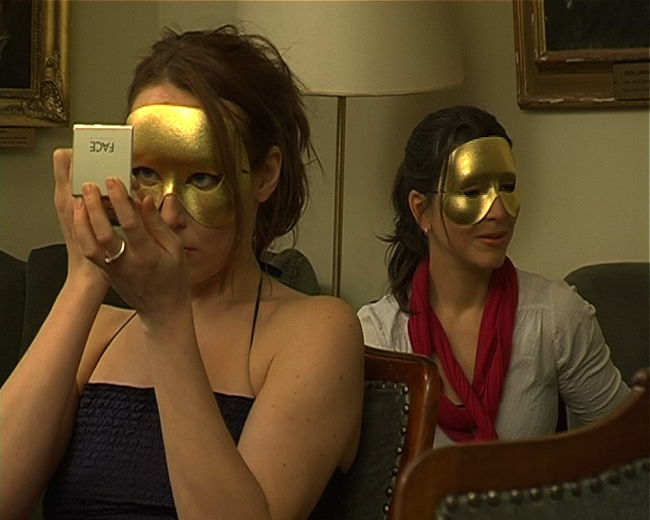
The theatrical draping of the exhibition space also resonates with the work on exhibition. Jack of all Trades by Tova Mozard is composed from individual interviews with the seven curators about their own projects, aspirations, and thoughts on the field as a whole. It was commissioned to use the reflections of the curators as its raw material to be re-worked, re-staged and edited by the artist. Mozard often works with an interview format as a narrative frame for her videos. Using a gesture that confuses the usual power positions of artist and curator, Tova Mozard has been given free hands to produce the video piece. The power over the image through selection and framing by the curator is in this case interwoven with the power that the artist has in selection and framing of the curator’s image. An interesting and unique relationship of trust, vulnerability and collaboration is established through this experimental format. The material was filmed in several sessions. Individual interviews formed the basis for a polyphonic script incorporating the individual utterances into one voice. This was followed by a re-staging, aptly held in the waiting room at the Royal Dramatic Theatre, where the curator’s role was re-enacted. The behind-the-scenes claustrophobia of the play within the play further filters and mediates the statements and ‘message’ of the masked curators.


The Young Dudes
 TOVA MOZARD